
10-Second Decisions That Lead to Workplace Injuries
Split-second workplace decisions can increase injury risk. Learn why employees make quick safety choices under pressure and how employers can create conditions that support safer decision-making.
It only takes one 10-second decision to snowball into a workplace injury.
Picture an employee carrying materials across a warehouse. The cart they normally use is parked several aisles away. Retrieving it would only take a minute, but they decide to carry the load by hand instead. Halfway through the task, the box shifts unexpectedly. They twist to keep it from falling, feel a sharp pull in their lower back, and finish the job anyway. What seemed like a harmless shortcut has now become a recordable injury.
Most workplace injuries do not begin with reckless behavior or a complete disregard for safety procedures. More often, they begin with routine decisions made while work is already in motion. An employee steps around an obstruction instead of taking a moment to clear a safer path. They adjust their grip instead of setting a load down to reset their posture. They climb onto a chair instead of retrieving a ladder because “it will only take a second.” Each decision feels reasonable in the moment, but together these small choices can create the conditions that lead to injury.
Even well-trained employees can make these types of decisions. In many cases, the issue is not a lack of safety knowledge. It is how people make decisions when balancing productivity, competing priorities, and changing work conditions in real time.
Why Split-Second Decisions Matter
In many workplaces, employees rarely have the opportunity to pause and evaluate safety as a separate step. Instead, they are solving problems, communicating with coworkers, meeting production goals, navigating equipment, and adapting to changing conditions simultaneously.
As these demands increase, people naturally begin relying on familiar routines and quick judgments rather than carefully evaluating every available option. Instead of asking, “What is the safest way to complete this task?” the decision often becomes, “What is the quickest way to keep work moving?”
This does not mean employees stop caring about safety. Instead, efficiency often becomes the default because attention is already divided among multiple priorities. In these moments, even experienced workers may overlook hazards they would normally recognize or skip steps they know are important.
Research in occupational safety and human factors has consistently shown that when employees work under time pressure, high cognitive demands, or competing priorities, they are more likely to rely on automatic decision-making instead of consciously evaluating risk. While these mental shortcuts help people work efficiently, they can also increase the likelihood of unsafe behaviors when workplace conditions change unexpectedly. The result is not one major mistake, but a series of small decisions that gradually increase risk.
Common Triggers Behind Split-Second Decisions
Certain workplace conditions consistently encourage employees to make quick decisions without fully evaluating the potential consequences. The table below highlights some of the most common decision triggers, the thought processes behind them, and how they can increase injury risk during routine work.
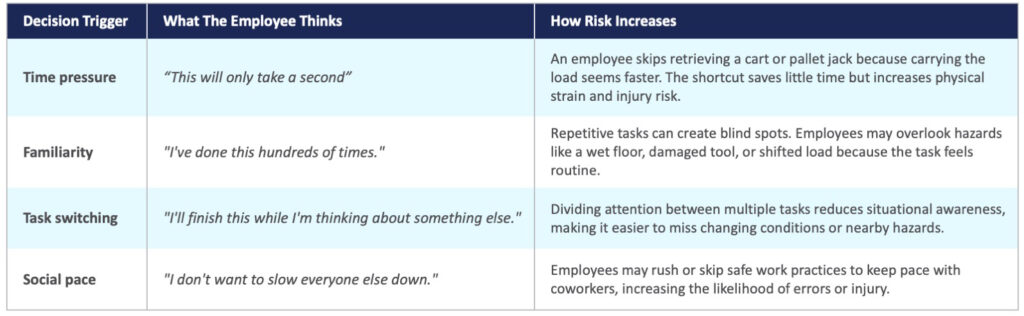
These conditions rarely occur in isolation. Time pressure, distractions, physical demands, and social expectations often overlap during routine work, making quick decisions feel both logical and necessary. Unfortunately, these are also the moments when injury risk can increase.
Supporting Safer Decisions in Real Work Conditions
Organizations cannot eliminate split-second decisions, but they can influence the conditions that shape them.
One of the most effective strategies is reducing unnecessary friction. If employees must walk across the facility to retrieve lifting equipment or search for the right tool, they are more likely to look for faster alternatives. Keeping equipment accessible where work is performed makes the safe choice the easy choice.
Leaders can also create a culture where pausing is viewed as good judgment rather than lost productivity. Employees should feel comfortable stopping to reposition a load, ask for assistance, or clear a work area without worrying that they are slowing down the operation. When safe decision-making is consistently reinforced, employees are more likely to prioritize it during busy moments.
Finally, organizations can look beyond compliance when evaluating workplace safety. Instead of focusing only on whether a procedure was followed, it can be equally valuable to understand why an employee felt compelled to bypass it. Identifying operational pressures, workflow challenges, ergonomic barriers, or unrealistic workload expectations can reveal opportunities to reduce injury risk before incidents occur.
Training remains essential, but preventing workplace injuries also depends on designing work environments that support safe decisions in real time.
Helping Reduce Workplace Injury Risk
Reducing workplace injuries requires more than reminding employees to “be careful.” Organizations achieve better outcomes when work environments are designed to support safe decisions before employees encounter pressure in the first place.
WorkCare helps employers identify the physical, operational, and organizational factors that contribute to workplace injuries through occupational health services, ergonomic assessments, on-site clinical support, and injury prevention programs. By addressing these conditions proactively, organizations can reduce physical strain, improve situational awareness, and support safer decision-making at the moment work is happening.
Most workplace injuries are not caused by ten seconds alone. They are caused by the conditions that shape those ten seconds. When organizations reduce unnecessary pressure, improve ergonomics, and make safe choices the easiest choices, small decisions are far less likely to become significant injuries.
Connect with WorkCare to learn more about creating safer workplaces.


Let’s Work Together
Ready to take your workforce health and safety to the next level?
Contact us today to learn how WorkCare can partner with you to create a healthier, safer, and more productive workplace.
