
Combining Neuroscience, Wearable Devices, and Coaching to Prevent Industrial Athlete Injuries
During a recent webinar – Athletes Get Coaching. Employees Get Training. That's the Problem. –WorkCare and its technology partner, PantherTec, explored the benefits of combining neuroscience, wearable devices, and proven coaching methods for industrial athletes to recognize unsafe movement patterns, consciously adjust behaviors, and reduce their workplace injury risks over the long term.
If you feel like people either can’t or won’t change risky behaviors when they have the chance, take heart. We learned from two experts during a recent WorkCare webinar that employees can reduce their musculoskeletal injury risk when neuroscience, data from wearable devices, and sports coaching principles are applied in the workplace.
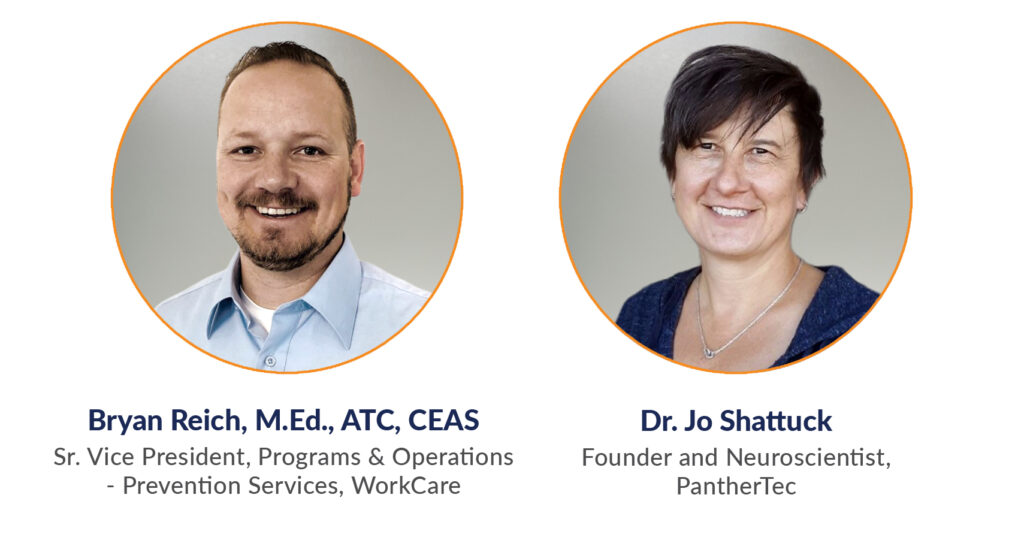
Industrial athletes employed by WorkCare clients now have the opportunity to pilot-test an injury prevention system that includes the use of a wearable device worn by elite athletes to detect and correct unsafe movement patterns while improving their performance and endurance in real time – before an injury occurs. The webinar featured:
- Bryan Reich, Senior Vice President, Programs and Operations, WorkCare Prevention Services, who has education and experience in workplace ergonomics and athletic training in sports and industry settings.
- Jo Shattuck, Ph.D., founder of PantherTec, developer of a wearable kinesthetic awareness training (KAT) system. Shattuck, a former professional racket sports athlete, has a master’s degree in sports science and a doctorate in neuroscience focused on motor learning.
WorkCare has partnered with PantherTec to introduce the tech company’s KAT/SafeCoach system in collaboration with WorkCare’s industrial injury prevention specialists in workplaces with musculoskeletal disorder exposure risks like exertion, repetition, lifting, and awkward postures.
What is Kinesthetic Awareness?
Kinesthetic awareness applies to movement in space and time – what Shattuck calls “the where and when of the body.” Using a KAT device with body sensors, workers become conscious of movement patterns that they did not previously think about or physically feel. The monitoring device notifies wearers when their body movements shift within safe and unsafe ranges. With recognition of movement patterns, users can adjust their body’s positioning in real time to help prevent injuries, avoid exacerbating existing conditions, and learn new motor-learning patterns.
Shattuck describes the KAT/SafeCoach system as “a movement intervention that allows an athlete, sports rehab patient, or worker to become aware of what they’re doing and develop optimal motor patterns that will last throughout their career.” The kinesthetic movement device is worn for specific period of time, not long enough for it to result in habituation, which is the opposite of behavior change. It’s not a one-size-fits all alert system, nor is it intended to be used as a “crutch or cattle prod,” she said.
Benefits of the KAT/SafeCoach system for employers and workplace coaches (injury prevention specialists) include the ability to collect data and correlate subtle changes in movement patterns with meaningful metrics, such as declines in complaints of work-related pain, OSHA-recordable injuries, workers’ compensation claims, medical care costs, and days off for recovery. Benefits for employees include the development of muscle memory – once a correct movement pattern is recognized and learned, it is retained – like riding a bike.
Neuroplasticity Supports Behavior Change
Shattuck said the ability to consciously change movement patterns that were unconscious is partly driven by neuroplasticity, the brain’s biological capacity to reorganize neural pathways and allow the central nervous system to rewire connections in response to stimuli, like being taught something new or experiencing environmental changes.
“The good news with neuroplasticity is that everything can be learned,” Shattuck said. “The technology we’re talking about provides insights into artificial proprioception (internal body awareness) or augmented feedback (external stimuli), which allows an individual to identify and adopt optimal movement patterns.”
The Problem with Workplace Training
While many organizations have effective employee coaching and injury prevention programs, Reich said he has observed that production – getting employees in the door and quicky trained – is often a higher priority for employers. In those types of workplaces, a typical training model features:
- Initial safety orientation and introduction to ergonomics
- Limited employee reinforcement after onboarding
- Expectations to quickly adapt and meet production expectations
- Reliance on employees to self-manage skill development
Without consistent, data-driven coaching, “movement quality deteriorates,” Reich said. “When things like stretching and correct body positioning get pushed to the wayside, musculoskeletal injury risk rapidly increases, making the response reactive rather than proactive.”
Differences between a typical workforce training model and a sports coaching model are instructive, Reich and Shattuck said. For example, in sports settings, athletes are motivated to improve their performance and reduce injury risk so they can remain competitive. Elite athletes typically receive daily coaching, injury prevention guidance, immediate care at the onset of musculoskeletal discomfort, and referrals to rehabilitation professionals when they are injured so they can expedite recovery and get back in the game. They are asked, “How do you feel today?”
At work, employees strive to sustain productivity, develop skills, and keep their jobs. They may decide to push through an injury, accepting physical discomfort as a byproduct of their job. Employees who receive limited training and minimal support for injury prevention and care guidance after an injury have to learn how to manage their own well-being, especially when no one asks, “How do you feel today?”
How to Leverage Kinetic Awareness in Your Workplace
Safety training alone is not enough. Wearable technology alone is not enough. Coaching alone is not enough. An injury prevention system that combines these essential functions is needed for employees to feel the difference between suboptimal and optimal body movement – the same way elite athletes need guidance to improve their speed or how they swing.
A wearable device provides data to stimulate kinetic self-awareness and drive self-correction. In-person coaching supports behavior change using the cues provided by the data. A coach with training in musculoskeletal injury prevention can provide education on correct body positioning in the context of the wearer’s personal characteristics and specific job demands. It may be as simple as adopting a more neutral posture in relation to the workspace, reducing the distance of a reach, or counting the number of unsafe lifts during a specific time period.
“The strongest prevention programs combine technology with clinical and operational support,” a critical aspect of total employee health service delivery models, said Reich, who works closely with WorkCare’s industrial injury prevention team. “In conjunction with the use of supportive technology, we can leverage the expertise of on-site specialists to help coach individuals on ways to reduce their injury risk,” Reich said. “The goal is not just to react to injuries faster, it’s to help employees move better before injuries happen. Real-time feedback creates real-time awareness.”
When training is thorough and followed up with movement detection and coaching, notable improvements in productivity, incident rates, morale, and the management of fatigue, stress, and underlying medical conditions that affect physical and cognitive function are expected.
In sports, athletes improve their performance through continual coaching, reinforcement, and support resources. Industrial athletes, who routinely face biomechanical demands that exceed those in sports, are often expected to do more with less, Shattuck noted. When combined, neuroscience, technology, and coaching help create stronger prevention programs.
Contact our sales team to learn more about pilot-testing the KAT/SafeCoach system in collaboration with WorkCare’s Incident Prevention team.


Let’s Work Together
Ready to take your workforce health and safety to the next level?
Contact us today to learn how WorkCare can partner with you to create a healthier, safer, and more productive workplace.
