
What Grip Strength Can Tell Us About Workforce Fatigue and Performance
Grip strength testing gives occupational health teams a fast, objective way to detect early workforce fatigue, support fit-for-duty decisions, and build safer, more resilient workforces.
Grip strength is a simple, fast, and widely accessible measure that can provide meaningful insight into employee fatigue, functional capacity, and overall performance readiness. In occupational health settings, it is increasingly recognized as a useful indicator that helps employers and clinicians better understand how fatigue may be affecting employees before it contributes to injury or reduced performance.
Why Grip Strength Matters in Occupational Health
Grip strength reflects more than hand function because it is a proxy for overall neuromuscular performance and can be influenced by fatigue, exertion, recovery status, and general physical conditioning.
In occupational settings, employees often perform repetitive tasks, sustain prolonged physical effort, or operate in environments that demand sustained attention and coordination. In these conditions, small changes in strength or endurance may be meaningful indicators of changing functional capacity.
Grip strength testing provides a quick and objective measure that can help occupational health teams better understand functional capacity at a specific point in time.
Large population-based research using U.S. National Health and Nutrition Examination Survey (NHANES) data has established normative reference values for handgrip strength in U.S. adults, demonstrating clear differences by sex and age (see below). Men consistently demonstrate higher absolute grip strength than women, and both sexes show a gradual decline in grip strength with increasing age. The study further supports grip strength as a functional biomarker associated with overall physical capability and health status.
The chart below shows population-based grip strength trends adapted from published NHANES normative data. Grip strength generally peaks in early to middle adulthood and gradually declines with age.
Average dominant-hand grip strength by age in U.S. adults
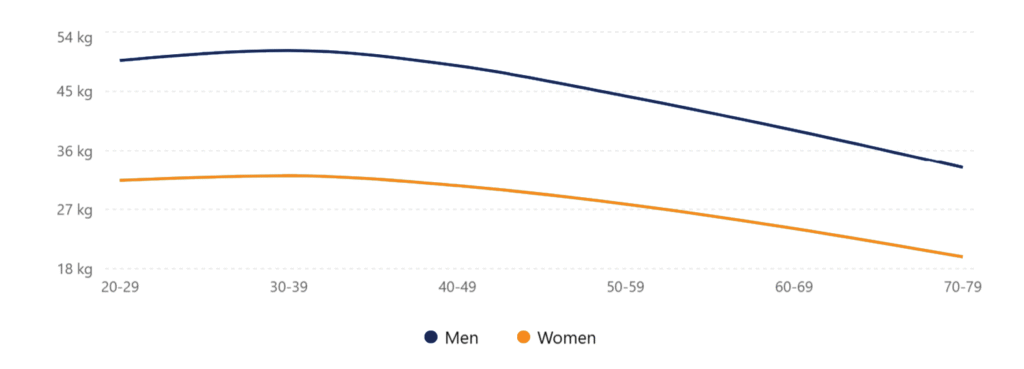
In an occupational health context, these normative values provide an important reference point for interpreting individual results. Rather than viewing grip strength in isolation, clinicians can compare an employee’s performance against expected population ranges by age and sex, helping distinguish normal variation from potential early functional decline or fatigue-related deviation.
How Fatigue Can Influence Grip Strength
Fatigue, both physical and cognitive, can reduce muscular efficiency and coordination. As fatigue increases, the body’s ability to generate consistent force may decline, even before an employee consciously recognizes feelings of tiredness.
This is particularly relevant in safety-sensitive roles where performance demands remain high across long shifts or repetitive tasks.
Grip strength may serve as one of the earlier measurable indicators of this decline because it relies on integrated neuromuscular function, including muscle activation, coordination, and endurance.
When Performance Changes Before Symptoms Appear
One of the challenges in workforce health and safety is that fatigue is not always easily recognized or reported. Employees may continue performing tasks despite reduced capacity, especially in high-demand environments.
Self-reported fatigue can be influenced by workplace culture, task urgency, or individual tolerance levels. As a result, subjective reporting alone may not fully capture early performance changes.
Objective measures such as grip strength testing can help identify subtle declines in physical readiness.
From Fatigue Insight to Workforce Readiness
Grip strength data can also contribute to broader discussions about workforce readiness. In occupational health, readiness refers to an employee’s functional ability to safely and effectively perform job demands at a given time.
Grip strength testing may help inform fit-for-duty evaluations, return-to-work assessments following injury or illness, readiness for physically demanding or safety-sensitive tasks, and baseline comparisons over time.
These applications are not intended to replace clinical judgment and should be considered alongside other relevant occupational health assessments.
Supporting Early Identification and Prevention
When used appropriately, grip strength testing can help occupational health teams identify potential signs of overexertion or reduced recovery. This supports timely intervention and may help reduce the likelihood of injury or performance-related incidents.
In this way, grip strength functions as one component of a broader occupational health strategy focused on prevention, early identification, and employee support.
It can also help employers better understand patterns of fatigue that may develop across shifts, tasks, or job roles.
Turning a Simple Measurement Into Actionable Insight
Grip strength testing is quick to administer and easy to integrate into occupational health workflows such as pre-placement or baseline screenings, periodic wellness or surveillance programs, post-injury recovery monitoring, and return-to-work clearance processes.
When tracked over time, grip strength data may help identify trends that inform workplace health strategies and targeted interventions.
Grip strength should always be interpreted within the broader clinical and occupational context alongside other functional assessments and job-specific requirements.
Building Stronger, Safer, and More Resilient Workforces
Grip strength is not a standalone measure of performance or health, although it can provide valuable insight when used as part of a comprehensive occupational health approach.
By helping identify early signs of fatigue and changes in functional capacity, grip strength testing may support more informed decisions about readiness, workload management, and employee safety.
WorkCare helps employers integrate practical, evidence-informed tools like grip strength testing into comprehensive occupational health programs designed to support workforce readiness, reduce injury risk, and promote employee well-being. Through WorkCare’s Occupational Health Screening services, employers gain access to the clinical expertise and screening capabilities needed to identify early signs of fatigue and build a stronger, safer workforce.
Contact us today to learn more.


Let’s Work Together
Ready to take your workforce health and safety to the next level?
Contact us today to learn how WorkCare can partner with you to create a healthier, safer, and more productive workplace.
