
What Your Team Needs to Know About Heat Illness Prevention This Season
Heat illness can escalate quickly in workplace environments. Learn how risk factors, hydration habits, and environmental conditions influence prevention, recognition, and response during high-heat exposure.
Heat illness is one of the most preventable occupational health risks, yet incidents continue to occur across indoor and outdoor worksites each year. Prevention depends on recognizing how quickly heat exposure, workload, and environmental conditions can combine to create dangerous situations.
Heat Illness Does Not Announce Itself
Heat illness does not always follow a clean path from mild to severe. While the stages are medically defined, employees do not always experience them in order.
Early signs may present as muscle cramping or fatigue during exertion. These symptoms are often dismissed as normal strain from physical work, especially in hot conditions where discomfort is expected.
As heat strain increases, symptoms such as dizziness, nausea, sweating, and weakness may appear simultaneously, and continued exertion can rapidly worsen the condition.
Heat stroke represents a breakdown in thermoregulation. The central nervous system is compromised when core body temperature rises above safe limits. Confusion, disorientation, or sudden behavioral changes may be more reliable indicators than sweating, thirst, or skin appearance.
Severity is not always predictable based on how suddenly symptoms appear. An employee can move from fatigue to critical illness in a short period of time depending on the length of exposure and their exertion level.
The Body Is Already Behind Before Warning Signs Appear
Hydration guidance is widely available, but consuming enough fluid to stay hydrated is often inconsistent in the workplace. These signs indicate that physiological strain is already present, not that it is beginning.
A common planning guideline is half of body weight in ounces of water per day, with increases during heat exposure or physical labor. While useful as a baseline, it does not account for personal fitness levels, variability in sweat rate, workload intensity, underlying medical conditions or medication use, or environmental stressors.
In practice, hydration failure is usually about timing, not knowledge. Employees may drink large amounts of water late in their shift rather than maintain steady intake across the day. That pattern does not correct dehydration quickly enough to offset ongoing heat exposure.
Electrolyte loss is another factor that is often underestimated. Sodium, potassium, and magnesium depletion can affect cognition, muscle function, and fluid retention. Water alone does not replace mineral losses during heavy sweating.
Common symptoms of dehydration often appear after performance has already begun to decline:
- Headache or lightheadedness
- Muscle cramping
- Nausea
- Unusual fatigue
- Confusion or slowed response
These signs indicate that physiological strain is already present, not that it is beginning.
The Environmental Factors That Increase Risk
Heat exposure risk increases when environmental and work conditions overlap.
Air temperature alone does not determine risk. Humidity, radiant heat, workload intensity, and airflow all interact to influence how effectively the body can cool itself.
High humidity reduces the body’s ability to rely on evaporation. Heavy physical work increases internal heat production. Direct sun exposure adds radiant load that is not always reflected in ambient temperature readings. Limited airflow reduces cooling efficiency, even when other conditions appear manageable.
These factors often shift throughout the day. A worksite that feels manageable in the morning can become significantly more demanding by midday without any obvious change in conditions other than time and sun exposure.
Risk Factors That May Be Present Before Work Begins
Some of the most significant contributors to heat illness are present before exposure to heat begins.
Employees may arrive already dehydrated, fatigued, or recovering from prior shifts. These conditions reduce the body’s ability to tolerate additional heat stress.
Acclimatization status plays a major role. Employees who are new to hot environments, returning after time away, or transitioning between climates have not yet developed full physiological adaptation. That adaptation affects sweat response, cardiovascular efficiency, and temperature regulation.
Medical conditions and medications can also influence heat tolerance. Antihistamines, antidepressants, diuretics, beta-blockers, and similar medications may interfere with sweating or fluid balance. These effects are not always visible or immediately recognized on the job.
Prior heat illness history is another factor that increases susceptibility. A previous episode can indicate reduced tolerance under similar conditions.
Heat Exhaustion and Heat Stroke: Recognizing the Point Where Risk Becomes Critical
The distinction between heat exhaustion and heat stroke is not just clinical. It determines whether the response is a rest-and-cool protocol or medical emergency. Getting that distinction wrong can be deadly. Table 1 lays out what separates the two conditions across three categories: what it is, how it presents, and what to do.
Table 1: Differences between heat exhaustion and heat stroke
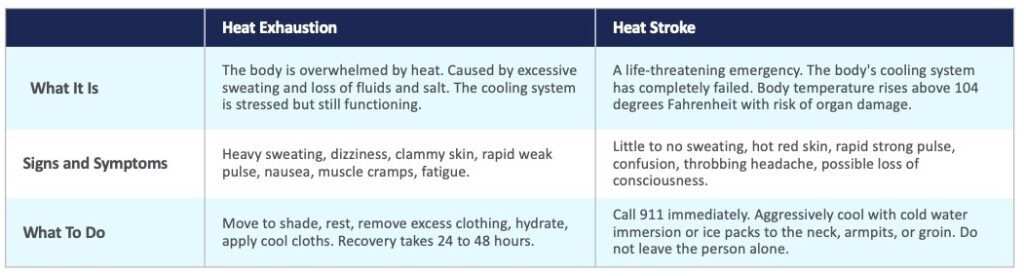
The practical test for anyone assessing a heat-affected employee is to pay close attention to mental status. Confusion, unusual behavior, or unresponsiveness should be treated as heat stroke until proven otherwise. The cost of treating heat exhaustion as heat stroke is a phone call to 911 that may not have been needed. The cost of treating heat stroke as heat exhaustion can be irreversible.
Prevention Is a Team Sport
Individual habits matter enormously in heat illness prevention, but the evidence from workplaces where heat illness is effectively controlled points consistently to one additional factor: teams that watch out for each other.
Employees can reduce risk by beginning the workday hydrated, maintaining steady fluid intake, taking breaks in cool or shaded areas, and adjusting workloads during peak heat hours when possible.
Regular rest periods support the body’s ability to recover between heat exposure cycles. Eating balanced meals helps replace electrolytes lost through sweat.
Team awareness adds another layer of protection. Employees may not always recognize early signs of heat illness in themselves. Coworkers who observe changes in behavior, coordination, or alertness can help identify the onset of illness sooner.
Early recognition and prompt action help prevent progression to more serious heat illness.
WorkCare Helps Employers Build Workplaces Where Prevention Comes First
Educating employees about heat illness is a strong starting point, but the employers who protect their people most effectively are the ones who build the systems, protocols, and clinical support behind that education.
WorkCare helps employers strengthen occupational health programs that address heat exposure through prevention-focused services, on-site clinical support, and incident prevention strategies. These resources help organizations identify risk conditions, support early intervention, and reinforce consistent workplace practices during high-heat periods.
To learn more, reach out to WorkCare.
Disclaimer: This information is intended for general education and prevention purposes only. It is not medical advice.


Let’s Work Together
Ready to take your workforce health and safety to the next level?
Contact us today to learn how WorkCare can partner with you to create a healthier, safer, and more productive workplace.
