
Medical Surveillance + Occupational Health Screening: What Employers Need to Know
Workplace medical surveillance and health screening trends provide valuable insights in both regulated and non-regulated environments when employers understand their distinct purposes and how they complement each other.
Workplace medical surveillance and occupational health screening programs fulfill distinct purposes. They also have complementary functions. Overlapping terminology can create confusion, especially with respect to regulated versus optional employee health and safety protection measures.
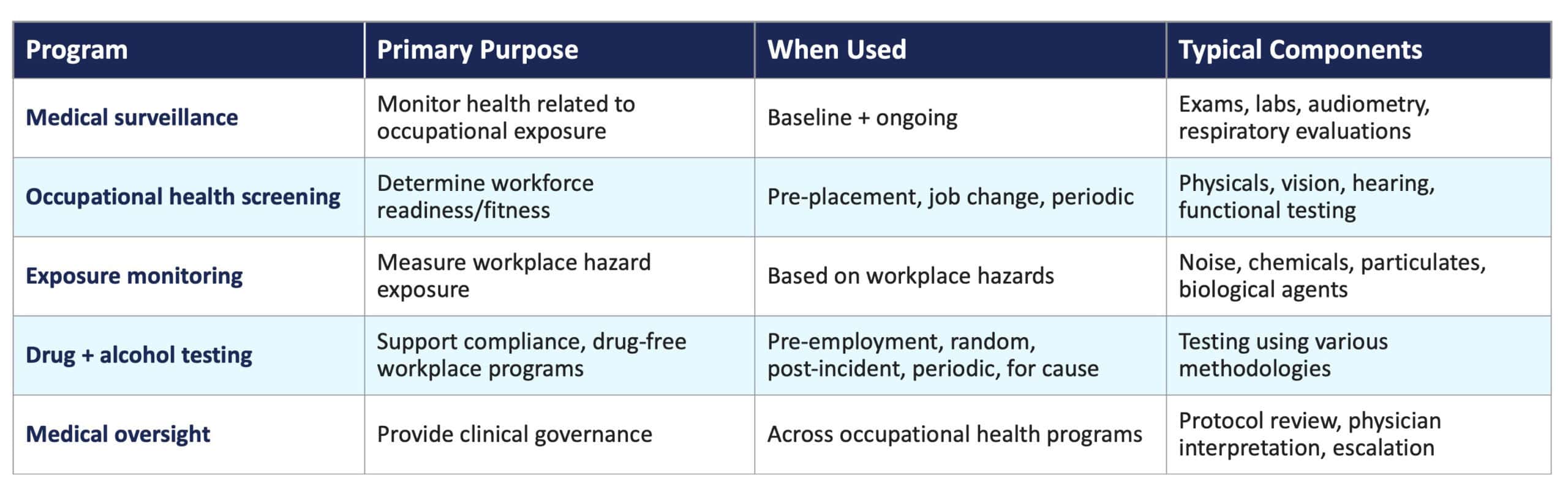
Medical surveillance and health screening trends provide valuable insights in both regulated and non-regulated environments. A fundamental understanding of their similarities, differences, and benefits is a good place to start. (See Table 1.)
What is Medical Surveillance?
Medical surveillance programs are required in industries with regulated health hazard exposure risks. Baseline and periodic physical exams are used to detect exposure-related changes in health status over time and identify existing medical conditions that may increase work-related injury or illness risk for a workforce population or individual employee.
Successful medical surveillance programs rely on collaboration among federal, state, and local agencies and stakeholder involvement, including industry associations, employers, labor organizations, and occupational health providers. The Occupational Safety and Health Administration, Mine Safety and Health Administration, and Federal Motor Carrier Safety Administration are among key federal agencies responsible for regulatory oversight and enforcement.
OSHA defines medical surveillance as the analysis of information to detect abnormal trends in workforce health status that necessitate preventive measures. The American College of Occupational and Environmental Medicine describes medical surveillance as a longitudinal, systematic process of evaluating and monitoring worker health over time in relation to potential or specific occupational exposures to hazardous physical, chemical, or biological agents.
In the 2026 edition of Occupational Health Services: A Practical Approach, co-editor Tee Guidotti, M.D., M.P.H., an occupational physician, explains the difference between medical surveillance and medical monitoring, another phrase that refers to workforce health status detection:
- Surveillance is “primarily used to determine a group experience with a particular disease outcome in a particular industry,” and secondarily to identify a work-related disease state or the absence of disease in an individual worker.
- Monitoring is used “when a particular outcome is not the focus of attention and the overall health experience of the individual or group is to be observed.” This may also be referred to as periodic health evaluation.
Medical surveillance services, such as those provided by WorkCare, are part of our Occupational Health Screening product line. They include the identification of exposure risks and injury/illness prevention measures, baseline and periodic exams, physician review of medical exam findings and follow-up with examinees, and regulatory compliance assurance.
Medical Surveillance Scenarios
Here are some scenarios to illustrate how surveillance applies in regulated workplaces:
- Employees who are exposed to noise at certain decibel levels for specified periods of time are required to receive baseline and periodic audiometric evaluations to detect standard threshold shifts. Hearing loss a common yet preventable work-related injury.
- A worker with risk of lead exposure is monitored for changes in blood-lead levels over time because lead can damage the kidneys and other systems of the body.
- Employees who are required to wear respiratory protection undergo periodic surveillance checkups. Pulmonary function tests like spirometry are used to measure lung capacity and respirator fit testing is required to ensure wearers are protected from exposure to airborne contaminants. A qualified provider must conduct a follow-up medical exam when an employee answers questions that indicate respirator use may compromise their health and safety.
- Periodic surveillance exams are required when there is risk of exposure to toxic chemicals, certain pharmaceutical ingredients, or biological agents like bloodborne pathogens. Early detection of related injuries and disease states improves health outcomes.
What is Occupational Health Screening?
Occupational health screening involves individual health assessments to determine whether a job applicant or employee is physically and mentally capable of performing essential job functions. Effective occupational health screening programs are tailored to the physical and environmental demands of specific roles. Non-regulated screening complements medical surveillance in regulated workplaces. It also adds value standing on its own.
Screening exams and tests provide insights into injury prevention and management strategies that can reduce sickness absence, workers’ compensation claims, OSHA-recordable incidents, and legal liability risk. Screening is cost-effective because it helps reduce productivity loss and turnover costs that occur when there is a worker-job mismatch.
Examples of occupational health screening capabilities offered by WorkCare include:
- Post-offer/pre-placement functional capacity evaluations
- Respiratory, hearing, and vision assessments
- Fit-for-duty and return-to-work evaluations
- Periodic health status checks, like blood pressure and immunization updates
- Drug and alcohol testing, e.g., pre-hire, random, periodic, post-accident, for cause
- Travel care, including vaccinations and disease prevention recommendations
Want to brush up on terminology? Refer to our Occupational Health Testing and Screening Glossary. For medical surveillance and occupational health screening guidance tailored to your organization’s needs, contact us today.


Let’s Work Together
Ready to take your workforce health and safety to the next level?
Contact us today to learn how WorkCare can partner with you to create a healthier, safer, and more productive workplace.
