
Oral Fluid vs. Urine Drug Testing: Which Workplace Testing Method is Right for Your Organization?
One of the most common misconceptions about workplace drug testing is that it measures impairment when in reality it is not designed to determine whether an individual was impaired at a specific moment in time. Employers should avoid equating a positive test result with real-time impairment and instead ensure testing policies align with applicable workplace health, safety, and employment regulations.
Workplace drug testing is an integral aspect of many workplace health, safety, and compliance programs. As testing options continue to evolve, employers are increasingly evaluating whether oral fluid or urine drug testing is the best fit for their workforce.
It’s not so much a matter of determining which testing method is “better” as it is about deciding which one best aligns with an organization’s workplace exposure risks, operational and regulatory environment, employee demographics, and occupational health safety objectives. Oral fluid and urine testing are both effective, scientifically validated approaches. Each offers distinct features depending on when the test is administered and what an employer wants to learn from the results.
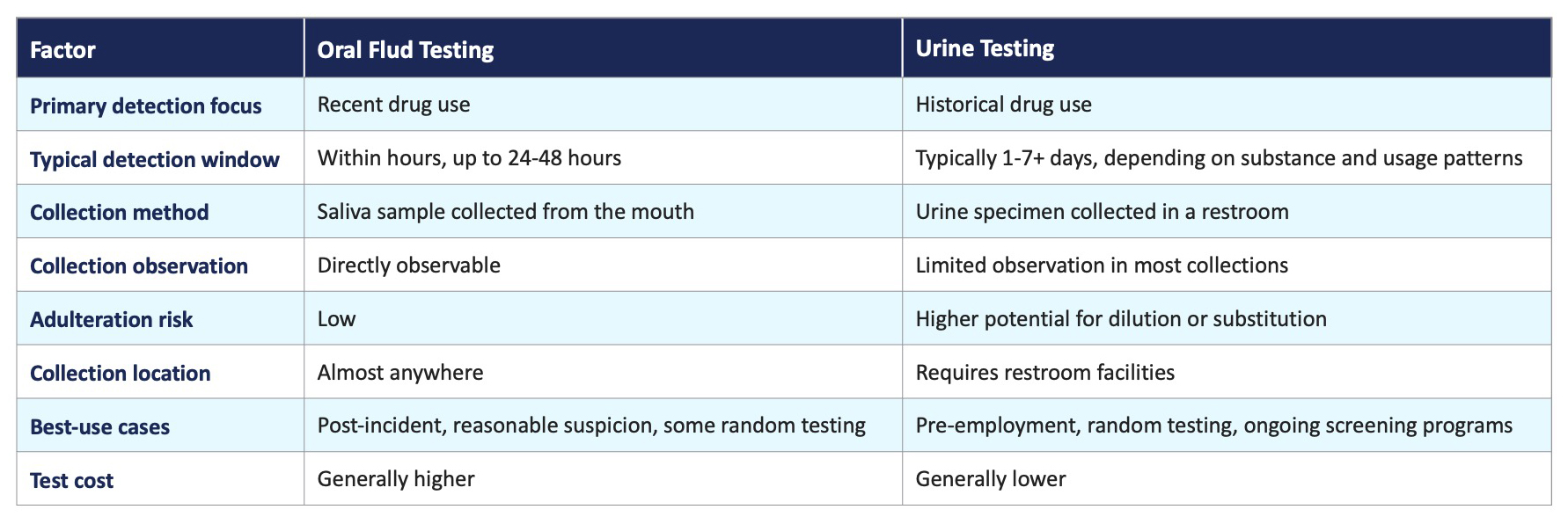
Oral Fluid vs. Urine Drug Testing: Quick Comparison
Oral Fluid Drug Testing
Oral fluid testing uses saliva collected from inside a donor’s mouth to identify the presence of drugs and drug metabolites. Because substances can appear in oral fluid relatively quickly after use, this testing method is often used when employers want insight into recent drug use. Among its advantages, oral fluid collection is simple, non-invasive, and can be performed in a variety of workplace settings.
Benefits:
- Detects more recent drug use
- Collection can be conducted virtually anywhere
- No restroom facilities required
- Direct observation helps maintain specimen integrity
- Reduced opportunity for specimen substitution or adulteration
- Convenient for remote, field-based, and mobile workforces
- Less administrative complexity during collections
Potential limitations:
- Shorter detection window than urine testing
- May not identify substance use that occurred several days earlier
- Collection may be affected if an individual has a dry mouth
- May not be the preferred option for every testing purpose
Urine Drug Testing
Urine testing is a widely used workplace drug testing method that has long served as the standard for many employer testing programs. Rather than focusing primarily on very recent use, urine testing is valued for its ability to detect drug metabolites over a longer period of time.
Benefits:
- Longer detection window
- Well-established testing methodology
- Broad testing panel options
- Widely used across industries
- Often preferred for pre-employment screening
Potential limitations:
- Collection requires restroom facilities
- Greater opportunity for specimen tampering if safeguards are not followed
- May involve additional collection logistics
- Can create privacy concerns for some employees
Frequently Asked Questions
Oral fluid testing is generally used to identify more recent drug use, while urine testing is often used to detect drug use over a longer detection window. The most appropriate testing method depends on an employer’s goals, workforce, operational environment, and regulatory requirements.
There is no one-size-fits-all answer. Both testing methods are valuable and may serve different purposes within a workplace testing program.
Oral fluid testing may be preferred when:
- Investigating a workplace incident
- Conducting reasonable suspicion testing
- Testing employees in safety-sensitive positions
- Testing remote or field-based workers
- Reducing opportunities for specimen tampering
- Simplifying collection logistics
Urine testing may be preferred when:
- Many employers choose to use both methods as part of a comprehensive workplace substance testing strategy.
- Conducting pre-employment screening
- Seeking a longer detection window
- Supporting established testing programs
- Maintaining consistency with existing policies and procedures
- Complying with current DOT testing requirements
No. One of the most common misconceptions about workplace drug testing is that it measures impairment. Drug testing is designed to identify the presence of drugs or drug metabolites within established detection windows. It is not intended to determine whether an individual was impaired at a specific moment in time. Employers should avoid equating a positive test result with real-time impairment and ensure testing policies align with applicable workplace safety, employment, and regulatory requirements.
Both testing methods are scientifically validated and highly accurate when conducted according to established laboratory and collection standards. The primary difference is not accuracy, but the timeframe of drug use each method is designed to detect.
Oral fluid testing generally offers greater specimen security because collections are conducted directly in front of the collector. This reduces opportunities for specimen substitution, dilution, or adulteration. Urine testing is also a reliable testing method when proper collection procedures and safeguards are followed.
No. Oral fluid specimens can be collected in most workplace environments without restroom facilities. This flexibility makes oral fluid testing especially useful for remote locations, field operations, mobile workforces, and post-incident situations where immediate collection may be important.
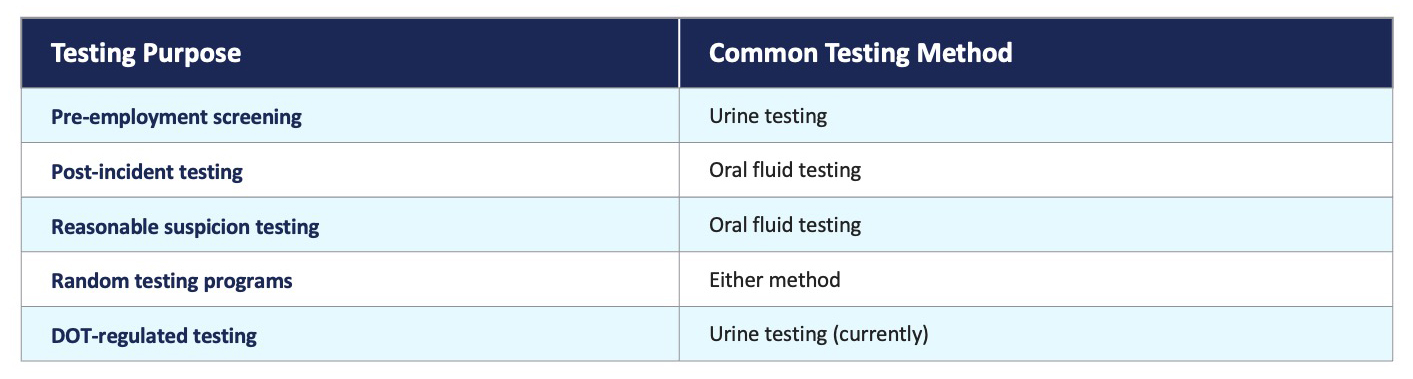
The U.S. Department of Transportation (DOT) has amended its regulations to allow oral fluid drug testing as an alternative to urine testing. However, implementation remains dependent on federal laboratory certification requirements. Until those requirements are fully met, urine testing continues to serve as the primary specimen type for most DOT-regulated drug testing programs.
Many employers use a flexible testing strategy based on the purpose of the test and operational needs. The best approach depends on workforce demographics, workplace risks, regulatory requirements, collection logistics, and organizational objectives.
Not necessarily. The most effective testing strategy depends on an organization’s workforce, safety risks, operational environment, and compliance obligations. Many employers find value in maintaining access to both testing methods and selecting the most appropriate option based on the situation.
Yes. Many organizations use both testing methods as part of a comprehensive drug-free workplace program. For example, an employer may use urine testing for pre-employment screening while using oral fluid testing for post-incident or reasonable suspicion situations. A dual-method approach can provide flexibility while supporting workplace safety, compliance, and workforce readiness.
How WorkCare Supports Drug-free Workplaces
WorkCare supports employers who prefer flexibility with both oral fluid and urine drug testing solutions. Our expert team helps organizations select the testing methodology that best aligns with their workforce, safety objectives, operational environment, and company policies. WorkCare provides guidance to help clients understand the strengths and limitations of each approach so they can make informed decisions that support a safer, healthier, and more productive workforce.
For many employers, oral fluid testing offers advantages such as convenient collections, direct observation, and reduced opportunities for specimen tampering. Urine testing continues to be widely used due to its established history and longer detection window. Employers subject to DOT requirements are encouraged to consult with WorkCare for guidance on current testing options and applicable regulations in affected industries with safety-sensitive positions.
Choosing a testing method is only one aspect of building an effective workplace drug testing program.
Employers must also consider:
- Workforce demographics
- Safety risks
- Operational realities
- Regulatory requirements
- Collection logistics
- Program administration
- Employee experience
WorkCare’s consultative approach focuses on helping organizations develop practical, scalable testing programs that support:
- Workplace safety
- Workforce readiness
- Risk reduction
- Operational efficiency
- Regulatory compliance
Looking for guidance on evaluating your workplace testing program? WorkCare can help assess your organization’s needs and develop a drug testing strategy that supports workforce readiness, safety, and compliance goals.


Let’s Work Together
Ready to take your workforce health and safety to the next level?
Contact us today to learn how WorkCare can partner with you to create a healthier, safer, and more productive workplace.
