
What Should You Do After the Third Similar Injury in the Same Department?
Repeated workplace injuries can signal underlying hazards or work-system issues. Learn how a root-cause approach can help identify contributing factors and strengthen injury prevention efforts.
Imagine a department where employees regularly handle materials throughout the workday. An employee develops a lower-back strain while lifting a box from a low storage area. The incident is investigated, the employee receives appropriate care, and the department reinforces safe lifting practices.
A few weeks later, a second employee experiences a similar injury while performing the same task. The circumstances are reviewed again, and the employee receives care and coaching. Then, a third employee reports a similar injury.
Three similar injuries in the same department may be more than a series of isolated incidents. While three injuries do not automatically point to a systemic problem or represent a formal threshold for action, they can be a signal to step back and look for patterns. The Occupational Safety and Health Administration (OSHA) recommends grouping similar incidents to identify trends and investigating the underlying hazards and causes that may contribute to them.
That means looking beyond what happened in each individual incident and examining the conditions surrounding the work. A root-cause approach can help employers identify what may be contributing to repeated injuries and where changes could help prevent another one.
1. Step Back and Look for the Pattern
An investigation of a repeated injury pattern begins by comparing incidents rather than treating each one as an isolated event. OSHA recommends reviewing injury and illness records, workers’ compensation information, incident investigation reports, job hazard analyses, and other available information to identify recurring patterns and assess workplace hazards.
Looking across incidents can help identify common factors, including:
- The task employees were performing
- Equipment, tools, or materials involved
- Workstation or environmental conditions
- Workload, staffing, scheduling, or production demands
- Procedures and training
- Changes to equipment, processes, or workflow
The purpose is not to assume that three injuries have the same cause. It is to determine whether the similarities warrant a closer examination of the work environment.
“The common factors I typically evaluate when similar injuries occur in a specific location include repetition rate per hour, body positioning during repetitive tasks, the amount of force being applied, and the weight of materials being handled. These factors often help identify the root causes of injuries and guide us toward the most effective interventions to support employees in that area.”
— Adam Deal, WorkCare Injury Prevention Specialist (IPS)
2. Look Beyond the Immediate Cause
An incident investigation can stop too early when the most visible explanation is treated as the root cause.
For example, an investigation may conclude that an employee experienced a back strain because the employee used poor lifting technique. That observation may be accurate, but it does not necessarily explain why the lifting occurred under conditions that increased the likelihood of injury.
OSHA cautions against attributing an incident solely to carelessness or failure to follow a procedure because doing so can overlook the underlying causes and systemic changes needed to prevent future incidents. OSHA’s incident investigation guidance encourages employers to examine why a procedure was not followed, whether production pressures played a role, whether training was adequate, and whether existing procedures were current.
A root-cause investigation can therefore move beyond what happened immediately before the injury and examine the conditions that contributed to it.
For example, poor lifting technique may be connected to a box being stored below an appropriate lifting height. The storage location may be connected to limited workspace. Limited workspace may be connected to increased inventory or a change in production volume. Each factor provides additional context that may be relevant to preventing another injury.
This approach shifts the focus from individual behavior alone to the relationship between the employee, the task, the equipment, and the work environment.
“When reviewing several similar injury incidents together, it is important to determine the demands of the work task including frequency, production volume, workstation design, and whether job rotations are being implemented. When workplace conditions begin to compromise safety and ergonomic principles, the risk of injury is high and requires immediate change to aid in injury prevention. Being able to identify whether the injuries stem from individual technique or from workplace design are crucial in determining the best solution to decrease the chance of work-related injuries from reoccurring.”
— Cynthia Moldanado, WorkCare Injury Prevention Specialist (IPS)
3. Examine Common Contributing Factors
Once a pattern has been identified, employers can examine the work system for factors that may be contributing to repeated injuries. OSHA recommends investigating the underlying hazards and safety and health program shortcomings associated with incidents, while also considering areas such as work organization, process flow, staffing, scheduling, work practices, and ergonomic risks.
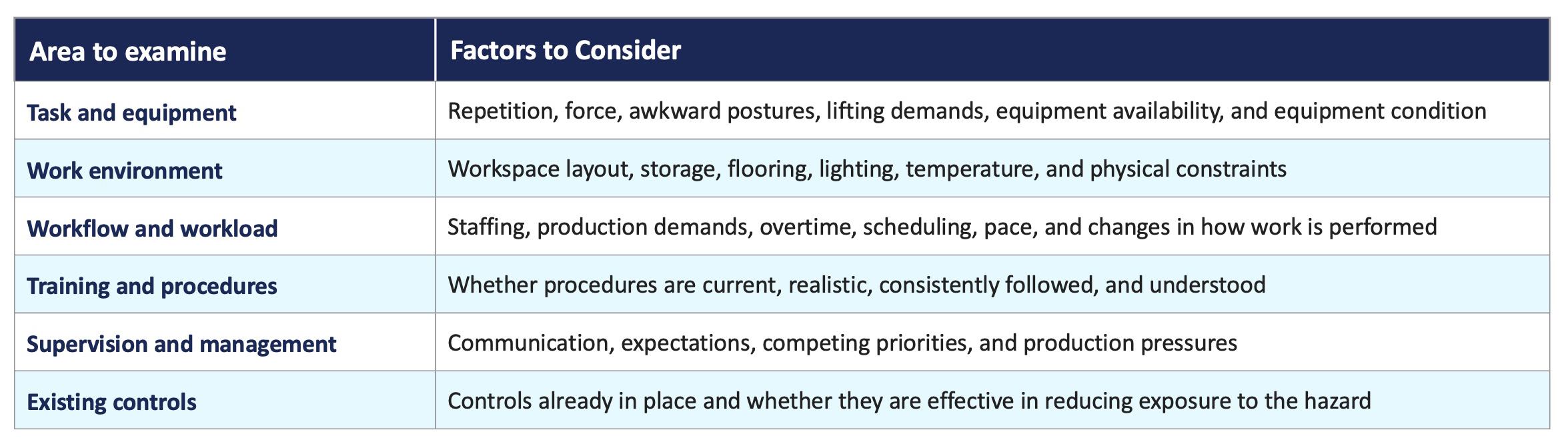
Workers can also provide valuable information during this process because they have firsthand knowledge of how work is actually performed. OSHA recommends involving workers in hazard identification and workplace inspections and considering their input when evaluating workplace changes.
The investigation may identify one contributing factor or several. The goal is to understand the conditions surrounding the repeated injuries well enough to determine where prevention efforts can have the greatest effect.
“If I have seen multiple injuries that are similar in nature, I start asking questions. What specifically were you doing when this injury occurred? Has any component of this job task changed recently? I start looking for any patterns. Did the injuries take place on the same day of the week or during the same timeframe of the day? I watch multiple employees perform the task and see if there are any key differences in how the task is being performed. This is where you have to start asking, ‘Why?'”
— Nicole Moss, WorkCare Injury Prevention Specialist (IPS)
4. Address Root Causes with Appropriate Controls
Identifying contributing factors is only part of the process. The next step is determining how to reduce or eliminate the hazards identified during the investigation.
NIOSH’s Hierarchy of Controls provides a framework for considering potential interventions, beginning with elimination and substitution, followed by engineering controls, administrative controls, and personal protective equipment. The hierarchy generally favors controls that remove or reduce the hazard at its source rather than relying primarily on actions that require ongoing individual behavior.
Depending on the findings, corrective actions may include modifying a workstation, changing how materials are stored or handled, improving equipment, adjusting a workflow, addressing workload factors, or updating procedures and training.
Training can remain an important part of prevention, particularly when employees need to understand a new process or control. However, retraining alone may not address a hazard that is built into the way work is designed.
For example, reminding employees to use proper lifting techniques may have a limited effect if materials continue to be stored in locations that require frequent awkward lifting. Changing the storage configuration may address the physical condition contributing to the risk, while training helps employees use the revised process appropriately.
5. Verify That the Intervention Worked
A corrective action should not mark the end of the investigation. Employers can evaluate whether the change actually reduced the risk and whether similar injuries continue to occur.
NIOSH’s Elements of Ergonomics Programs emphasizes evaluating interventions and making adjustments when necessary. The approach recognizes that an intervention should be assessed after implementation rather than assumed to be effective simply because it was put into place.
Follow-up can include reviewing injury trends, observing work practices, talking with employees, and determining whether the control is being used as intended.
An effective review can help employers determine whether:
- Similar injuries are continuing to occur
- The original hazard has been reduced or eliminated
- Employees are able to use the new control or process as intended
- Additional hazards or unintended consequences have emerged
- Workers report that the change is practical and addresses the risk
If similar injuries continue, the findings may indicate that the original cause was incomplete or that the intervention needs to be modified.
6. Recognize When Additional Expertise Can Help
Some injury patterns can be addressed through an employer’s existing safety and health processes. Others may require additional expertise, particularly when the contributing factors are complex, the cause is unclear, or injuries continue despite corrective action.
WorkCare’s Incident Prevention services include proactive injury prevention, ergonomic assessments, and consulting programs designed to help employers reduce workplace injuries.
For employers evaluating the potential business impact of these prevention efforts, WorkCare’s Incident Prevention ROI Calculator can help estimate the potential financial impact of reducing workplace injuries through proactive prevention strategies.
An injury prevention or occupational health professional can help employers examine the relationship between the worker, the task, and the workplace environment, identify contributing risk factors, and develop interventions appropriate to the conditions identified.
A Third Similar Injury Can Be an Opportunity to Look Deeper
A third similar injury can be a signal to step back from individual incidents and examine whether repeated exposure to the same task, environment, equipment, process, or organizational conditions is contributing to a pattern.
A practical root-cause approach can help employers move from incident response toward prevention: recognize the pattern, investigate beyond the immediate cause, identify contributing factors, address the underlying hazards, and evaluate whether the intervention worked.
The goal is to understand the conditions surrounding the work and identify changes that can help prevent a similar injury from happening again.
Want to learn more about how WorkCare can support your workplace? Connect with us.


Let’s Work Together
Ready to take your workforce health and safety to the next level?
Contact us today to learn how WorkCare can partner with you to create a healthier, safer, and more productive workplace.
