
Workplace Accommodations Support Women’s Reproductive Health Needs
Temporary, flexible accommodations help support women’s reproductive health so they can work safely, reducing the potential for lost time and legal liability exposure.
An estimated 80 million women comprise 50% of the U.S. workforce. Among them, about 43 million are of reproductive age; many others are in post child-bearing phases of life. Given these statistics, it behooves employers to provide solutions for women of all ages to work safely and comfortably throughout their careers.
One way to address women’s reproductive health needs in the workplace is the use of reasonable job accommodations during and after pregnancy or in response to menstruation, menopause, and perimenopause symptoms that affect productivity. Temporary, flexible accommodations help support women’s reproductive health so they can work safely, as needed, reducing the potential for lost time and legal liability exposure.
During a recent webinar on Workplace Accommodations Today: Legal Requirements and Emerging Expectations, WorkCare explored these issues with two experts:
- Irene Grace, M.D., M.P.H., a WorkCare vice president and associate medical director who is board-certified in occupational medicine and has more than 25 years of experience in the field. Her clinical responsibilities include Family and Medical Leave Act (FMLA) clarifications, return-to-work evaluations, and review of accommodation requests.
- Christine Bestor Townsend, an attorney and office managing shareholder with Ogletree Deakins, a national employment law firm, who advises employers on compliance, policy development, risk mitigation, and litigation avoidance. She provides guidance to help organizations align employment decisions with business objectives and legal obligations.

Workplace Accommodations Overview
While it sounds relatively straight-forward, job accommodation decisions can get stalled when medical, operational, and legal perspectives intersect. It’s important for all affected parties – from executive leadership to frontline supervisors – to be fully aligned on objectives and responsibilities when implementing accommodation policies. Creativity and mutual problem-solving are particularly beneficial in the context of business interests, legal requirements, and respectful employee relations concerning medical matters, according to Dr. Grace and Townsend.
Communication gaps can develop even when an organization has the best intentions. For example, written policies and procedures may not be clearly articulated. Supervisors may be unsure about how to facilitate job modifications. Employees may feel frustrated when timely action is not taken on their accommodation requests.
These types of gaps increase compliance risks for employers who are required to comply with applicable state and federal laws, including those designed to prevent discriminatory practices in the workplace. Consequently, when navigating accommodation processes, it’s essential for employers to identify:
- Who is involved in decision-making
- Where potential bottlenecks occur
- Tools and information teams need to be effective
“Accommodation responsibilities extend well beyond human resources,” Townsend said. “They touch safety, productivity, and employee retention across departments. You need supervisors who are ready to immediately loop in HR to avoid creating legal risk for the company. Successful strategies require education, training, and alignment between legal compliance and practical realities within organizations.”
Pregnant Workers Fairness Act
The Pregnant Workers Fairness Act (PWFA) adopted on June 27, 2023, has had a transformational effect in the workplace. The act expanded employment protections beyond those provided under Title VII of the Civil Rights Act, the Pregnancy Discrimination Act, and the Americans with Disabilities Act (ADA), increasing Equal Employment Opportunity Commission (EEOC) “scrutiny and enforcement of workplace accommodation processes” as employees attempt to exercise their rights, Townsend said.
Since employment protections provided under the PWFA apply to temporary conditions, a delayed response on the part of an employer can trigger a complaint and the need to legally justify a delay. The EEOC has been actively investigating and enforcing alleged non-compliance under a final rule that was adopted with broad bipartisan support on April 19, 2024. Under the Trump administration, proposed revisions to specific definitions within the rule remain on the agency’s regulatory agenda.
Townsend offered these PWFA compliance tips:
- A temporary limitation does not have to meet the definition of a qualified disability under the ADA, which requires an employee to be able to perform essential job functions, with or without reasonable accommodation, and without creating an undue hardship for the employer. Under the PWFA, an employee is not expected to perform essential functions when she is expected to return to full duty after post-partum recovery, Townsend said.
- The PWFA and the ADA both require an interactive process between the employer and the employee to ensure accommodations are acceptable and practical for all parties.
- The PWFA does not require any type of paid leave for a temporary disability; if an accommodation involves a temporary change to a different job, the same salary applies.
- Under the PWFA, leave is not mandated if there’s an accommodation option. An employer should not automatically default to leave when there are other options, for example, working from home while on bed rest during pregnancy.
- The PWFA covers conditions including miscarriage, gestational diabetes, preeclampsia, postpartum separation anxiety, and postpartum depression. In response to legal rulings, medical complications associated with an elective abortion are no longer covered.
- Pregnant employees do not have to provide a doctor’s note for “predictable assessments” like the need for extra bathroom or nutrition breaks, which rarely cause undue hardships for an employer.
Related documentation should only confirm that a temporary disabling condition exists and describe recommended accommodations. For example, a doctor may recommend that a woman lift no more than 10 pounds for the duration of her pregnancy. “Excessive documentation can delay accommodations and increase legal risks, so the PWFA regulations encourage employers to accommodate in the interim while working through the interactive process,” Townsend said.
To avoid legal missteps, employers are advised to:
- Thoroughly explore accommodation options before defaulting to leave of absence
- Train supervisors on employee rights and management responsibilities
- Adopt realistic expectations for return to work based on health status
- Immediately facilitate straight-forward (predictable) accommodation requests.
In addition, Townsend said employers should be prepared to accommodate a new mother’s need to pump milk or breastfeed. The Fair Labor Standards Act, which requires employers to provide reasonable break times and a private place for lactating women to express breast milk, and the PUMP Act (Providing Urgent Maternal Protections for Nursing Mothers) provide related regulatory guidance.
Menstruation and Menopause
As the workforce ages, menopause symptoms increasingly impact workforce participation and productivity. However, there is still stigma attached to both menstruation and menopause that make it hard for some women to speak up when symptoms affect their work performance, Dr. Grace said.
In response to increased advocacy and awareness of women’s physical and mental reproductive health concerns, some states have enacted specific employment-related protections. ADA provisions may be applied when serious menstrual cycle or menopause symptoms qualify as a disability,
Research indicates unmanaged menopause and perimenopause symptoms contribute to reduced productivity, increased absenteeism, and higher turnover among experienced employees. “We’re talking about a significant length of time during a woman’s working life,” Dr. Grace said. “From a safety perspective, women can experience fatigue, sleep disruption, and impaired cognitive function, which can increase the likelihood of errors and injuries in safety-sensitive positions.
“Addressing these issues through reasonable accommodations can improve performance and retention, as well as reduce downstream costs. Menopause accommodations are an investment in workforce stability and risk management. They should be viewed as an extension of workplace health and injury prevention rather than a compliance burden.”
Key Takeaways
After reviewing selected cases studies to illustrate the application of legal provisions and best medical practices (refer to the recorded session), Dr. Grace and Townsend offered these takeaways:
- Be consistent: Most legal exposure risk comes from inconsistent decision-making, delays, or breakdowns in communication. Successful organizations consistently follow clear processes, have well-trained supervisors, follow best-practice medical guidelines, and cultivate a rapid-response workplace culture.
- Be strategic: View accommodation as part of a broader workforce health management and employee retention strategy.
- Be supportive: When employees feel that their employer cares about their well-being and the health of their offspring, organizations are better positioned to maintain productivity, engagement, and trust.
WorkCare partners with employers to support these objectives and assist with the implementation of practical, sustainable solutions to keep employees safe, productive, and engaged.
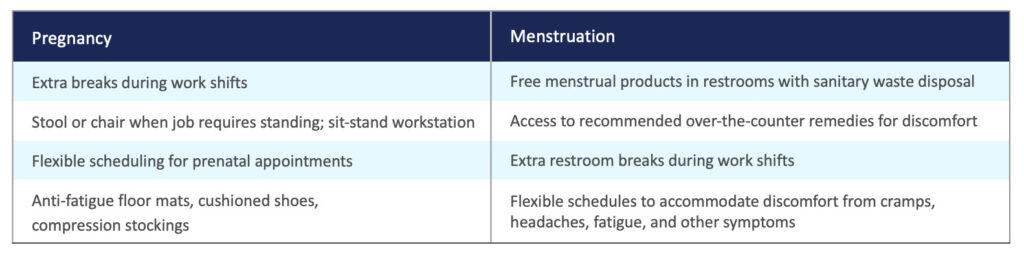
Table 1: Sample Accommodations


Let’s Work Together
Ready to take your workforce health and safety to the next level?
Contact us today to learn how WorkCare can partner with you to create a healthier, safer, and more productive workplace.
